BLOG DETAILS Table of Contents...
Read More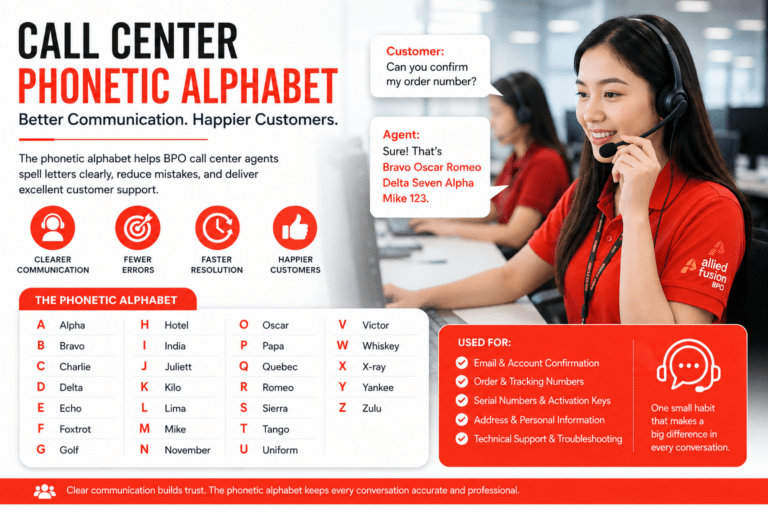
Clear communication is one of the most important foundations of excellent customer service. In a fast-paced BPO call center environment where agents handle hundreds of conversations daily, even a small misunderstanding can lead to customer frustration, incorrect orders, delayed resolutions, or compliance issues.
That is why many customer support teams rely on the phonetic alphabet.
The phonetic alphabet is a standardized communication system used in call centers to spell letters clearly during customer interactions. Instead of saying “B” or “D,” agents use words like Bravo and Delta to avoid confusion, especially during noisy calls, poor connections, or conversations involving different accents.
For businesses that depend on reliable customer support, accurate communication can directly impact customer satisfaction, first-call resolution, and brand trust. This is one reason why many companies partner with experienced inbound call center outsourcing services that prioritize communication training and customer experience.
Get a Free Outsourcing Strategy Call
We’ll assess your business needs and build a tailored outsourcing solution to help you save time and scale faster—no obligation, just smart solutions.
By signing up you agree to our Terms of Service and Privacy Policy.
What Is the Phonetic Alphabet in a Call Center?
The phonetic alphabet used in call centers is commonly based on the NATO phonetic alphabet. It assigns a specific word to every letter of the alphabet to ensure clarity during voice communication.
For example:
- A = Alpha
- B = Bravo
- C = Charlie
- D = Delta
Instead of saying:
“Your confirmation code starts with B.”
An agent would say:
“Your confirmation code starts with Bravo.”
This simple adjustment dramatically reduces communication errors during customer interactions.
In a global BPO call center environment, agents often communicate with customers from different countries, language backgrounds, and accents. The phonetic alphabet helps create a universal communication standard that improves accuracy and professionalism.
Why Clear Communication Matters in a BPO Call Center
In customer support, communication accuracy is not optional. A single misunderstood character in an email address, tracking number, account ID, or serial number can create major issues for customers.
This becomes even more important in industries such as:
- Ecommerce
- Healthcare
- Banking
- SaaS
- Telecommunications
- Logistics
- Technical support
Strong communication practices help improve:
- First-call resolution (FCR)
- Customer satisfaction (CSAT)
- Average handling time (AHT)
- Quality assurance scores
- Customer trust
For example, imagine a customer trying to confirm an order number during a poor mobile connection. Without the phonetic alphabet, letters like “M” and “N” or “B” and “D” can easily be misunderstood.
Using standardized communication reduces repetition and helps agents resolve issues faster.
This is one reason businesses increasingly invest in customer service support outsourcing providers that emphasize communication training and operational efficiency.
The Complete Call Center Phonetic Alphabet
Below is the standard phonetic alphabet commonly used in customer support and voice support outsourcing environments.
Letter | Phonetic Word |
A | Alpha |
B | Bravo |
C | Charlie |
D | Delta |
E | Echo |
F | Foxtrot |
G | Golf |
H | Hotel |
I | India |
J | Juliett |
K | Kilo |
L | Lima |
M | Mike |
N | November |
O | Oscar |
P | Papa |
Q | Quebec |
R | Romeo |
S | Sierra |
T | Tango |
U | Uniform |
V | Victor |
W | Whiskey |
X | X-ray |
Y | Yankee |
Z | Zulu |
Many inbound support teams train agents to memorize these terms during onboarding to ensure smoother communication during live calls.
How BPO Call Centers Use the Phonetic Alphabet Daily
The phonetic alphabet is used far more often than many people realize. In a professional call center setting, agents rely on it daily to improve communication accuracy and reduce costly mistakes.
Common Use Cases Include:
Order Verification
Agents use phonetic spelling to confirm customer order IDs and tracking numbers.
Example:
“That’s Tango, Romeo, Echo, Echo, one-two-three.”
Email Address Confirmation
Email mistakes are extremely common during support calls.
Instead of:
“Is that jsmith@gmail.com?”
Agents say:
“That’s Juliet, Sierra, Mike, India, Tango, Hotel.”
Technical Support Troubleshooting
Technical support teams frequently verify:
- Device serial numbers
- Ticket IDs
- Product activation keys
- Password reset codes
This is especially important for businesses using technical support outsourcing services where communication precision affects issue resolution times.
Billing and Account Verification
Financial and subscription-based businesses rely on accurate account verification to maintain security and compliance.
International Customer Support
Global customers may pronounce letters differently depending on accents and language backgrounds. The phonetic alphabet helps standardize communication across regions.
Benefits of Using the Phonetic Alphabet in Customer Support
Using the phonetic alphabet offers several operational and customer experience advantages.
Reduced Communication Errors
The biggest advantage is clarity. Similar-sounding letters are less likely to be misunderstood.
Faster Call Resolution
Agents spend less time repeating information, reducing average handling time and improving efficiency.
Improved Customer Confidence
Customers feel more confident when agents communicate professionally and accurately.
Better First-Call Resolution
Accurate information gathering helps resolve customer issues during the first interaction.
Stronger Quality Assurance Scores
QA teams often evaluate communication clarity as part of agent performance reviews.
Better Multilingual Communication
The phonetic alphabet supports smoother communication between global customers and offshore support teams.
Businesses seeking scalable communication support often explore voice support outsourcing solutions in Cebu because of the Philippines’ strong English proficiency and customer service culture.
Common Communication Problems in Call Centers
Without structured communication standards, call centers often experience recurring issues that affect customer satisfaction.
Similar Sounding Letters
Examples include:
- B and D
- M and N
- P and T
- F and S
Poor Call Quality
Mobile networks, VoIP delays, and low bandwidth can distort conversations.
Accent Differences
Global support environments involve customers and agents from many language backgrounds.
Background Noise
Busy environments can interfere with verbal communication accuracy.
Repetition Fatigue
Customers become frustrated when they need to repeat information multiple times.
The phonetic alphabet helps reduce these communication barriers while improving operational consistency.
How BPO Companies Train Agents to Use the Phonetic Alphabet
Professional BPO providers integrate phonetic alphabet training into onboarding and quality assurance programs.
Training usually includes:
- Roleplay exercises
- Mock customer calls
- QA evaluations
- Communication coaching
- Accent neutralization
- Script simulations
- Live call monitoring
Many companies also incorporate the phonetic alphabet into CRM workflows and call handling procedures.
At high-performing customer support centers, communication training is treated as an essential part of customer experience management, not just a basic skill.
Why Philippine BPO Call Centers Excel in Customer Communication
The Philippines remains one of the world’s top outsourcing destinations for customer support and voice services.
Several factors contribute to the country’s reputation for communication excellence:
Strong English Proficiency
The Philippines has one of the highest English proficiency rates in Asia.
Cultural Compatibility
Filipino agents are highly familiar with Western communication styles and customer expectations.
Customer Service Orientation
Filipino customer support professionals are known for empathy, patience, and conversational professionalism.
Scalable 24/7 Support
Businesses can maintain around-the-clock operations with offshore support teams.
Specialized Voice Support Expertise
The country has decades of experience handling:
- inbound customer support
- technical support
- telesales
- help desk operations
- customer retention campaigns
This is why many businesses choose Cebu call center outsourcing services when building scalable support operations.
Real Call Center Example: Why the Phonetic Alphabet Matters
Imagine a customer calling to reset a software license.
The activation code is:
B7DMPQ
Without the phonetic alphabet, the customer may hear:
- B as D
- M as N
- P as T
This creates delays, frustration, and longer support calls.
A trained support agent instead says:
“That’s Bravo Seven Delta Mike Papa Quebec.”
The issue gets resolved faster, the customer experience improves, and the support interaction feels more professional.
The Role of Communication in Modern Customer Experience
Today’s customers expect fast, accurate, and seamless support experiences across every channel.
Even with AI chatbots and automation becoming more common, human communication remains critical in:
- voice support
- escalations
- technical troubleshooting
- account verification
- customer retention
Businesses that invest in communication quality often see improvements in:
- retention
- customer loyalty
- online reviews
- brand reputation
- operational efficiency
Strong communication systems are a major reason why companies continue partnering with experienced BPO call center providers that prioritize training and customer experience standards.
Final Thoughts
The phonetic alphabet may seem like a small communication tool, but in a fast-moving call center environment, it plays a major role in improving customer interactions, reducing errors, and increasing operational efficiency.
For modern BPO call centers, communication clarity directly impacts customer satisfaction and business performance. From order verification to technical support, the ability to communicate accurately helps create smoother and more professional customer experiences.
As customer expectations continue to rise, businesses that prioritize communication excellence will remain ahead in the competitive customer support landscape.
Frequently Asked Questions
What phonetic alphabet do call centers use?
Most call centers use the NATO phonetic alphabet, which includes standardized words like Alpha, Bravo, Charlie, and Delta to improve communication accuracy during customer calls.
Why do BPO agents use Bravo and Alpha during calls?
BPO agents use words like Bravo and Alpha to clearly spell names, account numbers, email addresses, and tracking codes without confusion caused by accents or poor call quality.
Does the phonetic alphabet improve customer satisfaction?
Yes. Using the phonetic alphabet reduces misunderstandings, shortens call times, and improves first-call resolution, leading to better customer satisfaction.
How do inbound call centers train agents on communication clarity?
Inbound call centers train agents through roleplay exercises, live call monitoring, mock scenarios, QA evaluations, and phonetic alphabet drills.
Is the phonetic alphabet important for technical support outsourcing?
Yes. Technical support teams regularly use the phonetic alphabet when verifying serial numbers, activation keys, passwords, and troubleshooting information with customers.
Why is communication important in a BPO call center?
Clear communication helps reduce customer frustration, improves accuracy, increases customer satisfaction, and supports faster issue resolution in call center operations.

Yuko Tsushima
Yuko Tsushima is the Chief Executive Officer of Allied Fusion BPO, where she leads the company’s mission to deliver reliable, people-centered outsourcing solutions for global businesses. With deep experience in operations, client success, and workforce development, Yuko is passionate about building high-performing teams and creating sustainable partnerships that drive long-term growth. She regularly shares insights on outsourcing strategy, customer experience, and the evolving BPO landscape.